OEAC
Project overview
The Orbital Electromagnetic Acceleration Corridor (OEAC) is a conceptual architecture for orbital electromagnetic acceleration infrastructure intended to support future cargo transportation between Earth and the Moon.
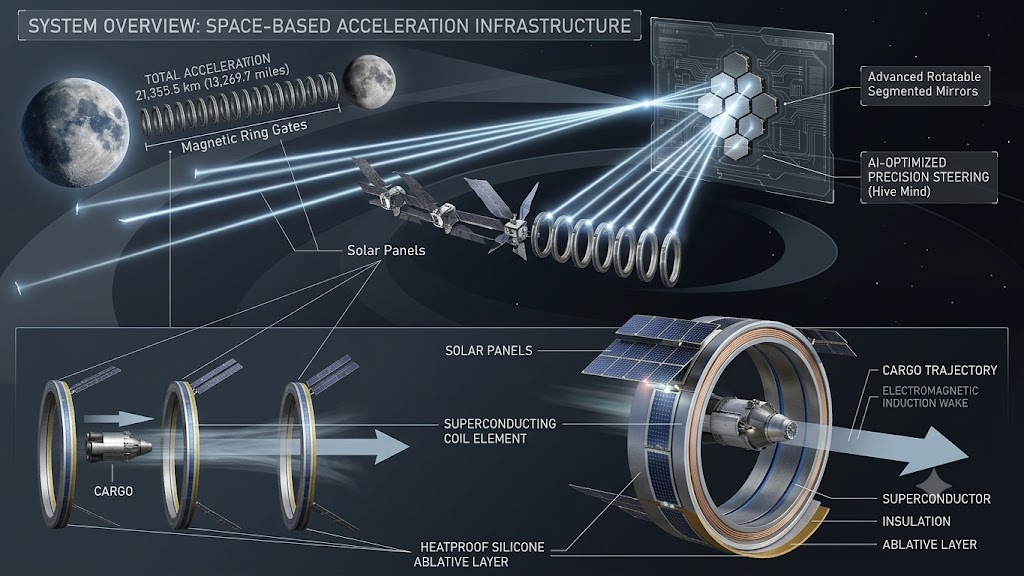
The proposed system consists of a sequence of electromagnetic acceleration rings positioned in Earth orbit. Instead of requiring a cargo vehicle to provide all of its required velocity change through onboard chemical propulsion, the infrastructure would transfer energy to the vehicle externally.
The concept is motivated by the long-term logistics challenge of transporting increasing quantities of cargo through the Earth–Moon system.
The current study is primarily an investigation of physical and engineering feasibility. Major questions include momentum transfer, orbital maintenance, synchronization, structural loads, power requirements, thermal management and rendezvous accuracy.
CONCEPT
System architecture
01 · PROBLEM
Earth–Moon logistics
Future lunar exploration and sustained lunar operations could require significantly larger quantities of cargo than individual exploration missions.
Chemical propulsion remains constrained by the rocket equation: propellant must itself be accelerated, creating a strong relationship between payload mass, propellant mass and required velocity change.
OEAC investigates whether some of the required energy could instead be supplied by permanent infrastructure external to the cargo vehicle.
02 · ACCELERATION
Electromagnetic rings
The proposed architecture uses a sequence of electromagnetic acceleration elements through which cargo vehicles would pass.
Each stage would contribute additional velocity, allowing the total energy transfer to be distributed across multiple pieces of infrastructure.
The concept therefore shifts part of the transportation problem from onboard propulsion toward infrastructure, energy generation, storage, synchronization and stationkeeping.
03 · ENERGY
Orbital solar infrastructure
The concept includes a distributed orbital solar-energy architecture referred to as the "Terran Swarm".
Solar collectors would generate electrical energy that could be stored and delivered to the acceleration infrastructure when required.
The feasibility of this architecture depends heavily on the required energy per cargo vehicle, acceleration frequency, conversion efficiency and available power generation capacity.
04 · PHYSICS
Momentum transfer
One of the fundamental challenges is conservation of momentum.
Transferring momentum to a cargo vehicle necessarily produces an equal and opposite reaction on the acceleration infrastructure and ultimately the orbital system.
The resulting orbital perturbations and the stationkeeping requirements of the acceleration infrastructure are therefore central to the concept.
05 · ENGINEERING
Key technical challenges
Momentum
Determine how repeated acceleration events affect the orbital state of the infrastructure.
Synchronization
Maintain precise timing and orbital alignment between multiple acceleration stages.
Structural loads
Determine the forces and stresses generated during electromagnetic acceleration events.
Thermal management
Manage waste heat associated with high-power electromagnetic systems and their supporting electronics.
Power requirements
Determine the generation, storage and transmission capacity required for repeated cargo acceleration.
Rendezvous
Achieve the positional and velocity accuracy required for cargo vehicles to interact with multiple acceleration stages.
06 · RESEARCH OBJECTIVES
Questions under investigation
OBJECTIVE 01
Electromagnetic performance
Determine whether the required acceleration can be produced while maintaining realistic electrical, structural and thermal constraints.
OBJECTIVE 02
Orbital dynamics
Quantify momentum transfer and determine the stationkeeping requirements resulting from repeated cargo acceleration.
OBJECTIVE 03
Energy infrastructure
Estimate the energy generation and storage requirements of an orbital solar-power network supporting the system.
OBJECTIVE 04
Orbital synchronization
Investigate how multiple acceleration stages could maintain useful alignment for repeated cargo transfers.
OBJECTIVE 05
Mission performance
Evaluate achievable cargo velocities, acceleration levels and overall system performance under defined mission assumptions.
07 · POTENTIAL APPLICATION
Earth–Moon transportation
If the underlying technical challenges could be resolved, orbital electromagnetic acceleration infrastructure could potentially become part of a reusable transportation architecture within the Earth–Moon system.
Possible applications could include cargo transportation, orbital logistics, resource transportation and other missions where repeatedly supplying large quantities of propellant is undesirable.
The concept remains an investigation rather than a demonstrated transportation system. Its value therefore depends on quantitatively testing the identified physical and engineering constraints.
08 · REFERENCES
Selected sources
Tsiolkovsky, K. E. (1903). Exploration of Outer Space by Means of Rocket Devices.
Wertz, J. R., Everett, D. F., & Puschell, J. J. (2011). Space Mission Engineering: The New SMAD. Microcosm Press.
Curtis, H. D. (2020). Orbital Mechanics for Engineering Students. 4th Edition. Elsevier.
Fortescue, P., Swinerd, G., & Stark, J. (2011). Spacecraft Systems Engineering. 4th Edition. Wiley.
Onnes, H. K. (1911). The Superconductivity of Mercury.
Larbalestier, D., Gurevich, A., Feldmann, D., & Polyanskii, A. (2001). High-Tc Superconducting Materials for Electric Power Applications. Nature, 414, 368–377.
National Academies of Sciences, Engineering, and Medicine (2022). Origins, Worlds, and Life: A Decadal Strategy for Planetary Science and Astrobiology 2023–2032.
NASA. Artemis
European Space Agency. Terrae Novae
PROJECT ARCHIVE